DECISION 2026
If you think your congressional representative’s first job should be creating legislation and giving speeches in the U.S. House, we have some bad news for you.
If you were hoping they spend most of their time on a never-ending fundraising spree, you’ll be pleased by the findings in this report.
What on Earth is All of This Money For?
This is not an attack on August Pfluger.
Pfluger has a long track record of exceling at everything he ever put his hand to, so it was not surprising to anyone that he took to his new role in Congress like a duck to water.

This is about a system of government that most Americans believe to be deathly-ill and in need of serious reforms — mainly regarding the money in politics — where the rich “buy the pot” in every election.
But it’s certainly not August Pfluger’s fault, and if any American examines the Federal Election Commission reports from their representative and senators, it’s going to show the problem in stark relief, especially with regard to the volume of dollars passing through these campaigns.

An Alternate History Thought Experiment
If, when the Watergate scandal finally unfolded, the American people had (rightly?) seen there was way too much money in the elections racket — and decided there-and-then to do something about it — they might have decided that federally funding elections was a good idea.
Give a set amount to all candidates and maybe let ideas win the day instead of money.
There is absolutely no way America would be experiencing this internecine strife had we made that change, and it would have saved everyone untold sums of money (trillions), while frustrating only advertisers and the folks who make a living off of raising money for politics. (Which is a pretty lucrative business, by the way.)
Instead, we decided to double-down on money in politics, and then we doubled that several times over. Each election cycle leading to more-and-more inflammatory rhetoric in order to spur the base into digging deep into their pockets once again.
As a result of our decision to do nothing, we created an ungainly never-ending elections cycle that almost everyone claims is driving them crazy.
How The Fundraising Works
Why on Earth has it been necessary for August Pfluger to raise $12,400,692?
Pfluger has faced opponents twice; during his initial primary run and the 2020 general election, and again in this year’s general election. He had no serious challengers in between.
Pfluger’s first Democratic Party opponent raised about $100,000 to challenge him in a race where the Republican was an absolute shoo-in to win.
Pfluger raised $2,598,806 and spent $2,004,400, or about 20-to-1.
This year, his opponent has worked hard to raise about $89,000.
August Pfluger Donations and Spending

Where Does It All Go?
In order to understand the nature of the beast, so to speak, it’s necessary to be familiar with the tools of a modern politician.
We’ve always had campaign funds, and every elected representative has one of those, which they use to pay the bills for their actual campaigns.
Then there are the leadership funds, PACs and Super PACs created in the modern era.
August Pfluger has the Pfluger Victory Committee, and the Raptor PAC, along with another thing called Pfriends of Pfluger, which appears to have very limited activity.
By contrast, August Pfluger for Congress, the Victory Fund and Raptor PAC are very active, and the FEC filings for these funds run regularly to 100-pages and more, listing all of the contributions and disbursements between them.
Stepping Up Your Game
When it comes to fundraising, you can only get away with so many backyard barbecues before you have to get serious.
If you’re going to raise enough money to get some kind of good committee assignments, for instance, you’re going to have to step it up, and rich folks aren’t going to come to a Waffle House or an Olive Garden for your event – a venue they wouldn’t normally patronize.
So, fundraising actually costs a lot of — guess what? Money.
Just plain ol’ money. And the more money you put into, apparently, the more money you get out of it, so campaigns need two distinct prongs.
Raising money from the rich on the one hand, and then riling up the base on the other, and both these things are critical.
You need money from the rich, and votes from the base. You’ll take money from the base too, but it’s their votes that are crucial. There definitely aren’t enough rich votes to win an election in America.
Drilling Down on Details
(The following figures are from Pfluger’s two most active committees, the Pfluger Victory Fund and August Pfluger for Congress.)
When you unpack the FEC filings, they show August Pfluger’s actual congressional election committee received $4,955,822.68 from his various funds and PACs, to pay campaign bills with.
The rest of the $12 million the congressman has raised are tied up in fundraising and donating to less pfortunate campaigns.
One has to do some inferencing when poring over these filings in order to make sense of things. You can’t just look at things labeled “fundraising” to get the whole fundraising picture.
There are catering and lodging expenses, supporter gifts and things like that you have to factor in.
For instance, if you are a congressman from West Texas doing fundraising, you need to put some thought into the kind of neat little gifts wealthy donors expect to receive when they fork over that kind of cash.


Cool things from upscale brands like Patagonia and KUIU, neat custom-made polo shirts, or maybe nice little gifts from swanky places in Washington, D.C. like Tuckernuck.
It’s an important consideration apparently.
The right venues are also important.

Park City, Utah, seems to be a popular fundraising destination. There were some events there, at the St. Regis Deer Valley Resort and at the Stein Eriksen Lodge, and events at warmer resorts like St. Joe’s in Panama Beach, Florida.

These venues cost quite a bit to rent. On the order of $30,000 and up, which may or may not include the catering and the bar — or lodging.
Of course, there are a ton of fundraising opportunities in Washington, D.C., as shown by catering expenses from more than a dozen nice restaurants in the Capitol metro area during the last reporting period, along with what must be smaller events throughout the year at places like golf clubs in New Jersey, Maryland and Virginia.
It Takes a Fundraising Village
Pfluger can’t just do it all by himself, though, so like most federally elected officials, he pays fundraising consultants to put everything together for his campaign events, and for important services like “list acquisition” where campaigns buy fresh lists of proven givers.
According to the most recent report for two committees, he paid Hooks Consulting $85,997 for their services, and Lilly & Co. $16,841.62 for theirs, along with several other firms.
According to a spreadsheet from the FEC data with all of the fundraising consulting disbursements, Pfluger has spent a total of $1,991,419.25 since 2019.
When figured with the catering bills for the most recent cycle, which totaled more than $500,000 anyone can see it adds up quickly. (In fact, Pfluger’s American Express bills totaled $920,910.70 over the last two years, according to FEC reports for this pair of committees.)
Different Kinds of Donors
When it comes to scrutinizing individual donations to these campaigns, the contrasts between the Republican side and the Democratic side are staggering.
It takes less than 30 minutes to look at every single donation received by Pfluger’s Democratic Party opponents.
It literally takes hours to make your way through one year of Pfluger’s FEC filings.

For instance, August Pfluger’s opponent in 2020 received a total of 486 donations, including several from himself to begin with, and the largest single donation he took was for $2,800 — but he only had six donations above the $2K level — and 18 donations between $1,500 and $1,000.
The bulk of donations to his campaign were for $100-or-less.
This is the same pattern that exists for Claire Reynolds. She personally invested quite a bit in this campaign, and there are donations from people in her hometown, and $1,000 from her dad, but most of her contributions come from folks in the district and represent modest amounts.

The bulk of Pfluger’s campaign cash comes from checks most households in America couldn’t dream of writing. And wouldn’t.


Federal Election Commission rules state the maximum contribution limit an individual can give directly to a candidate’s committee is $6,600 if someone donated the maximum $3,300 for the primary and general elections.
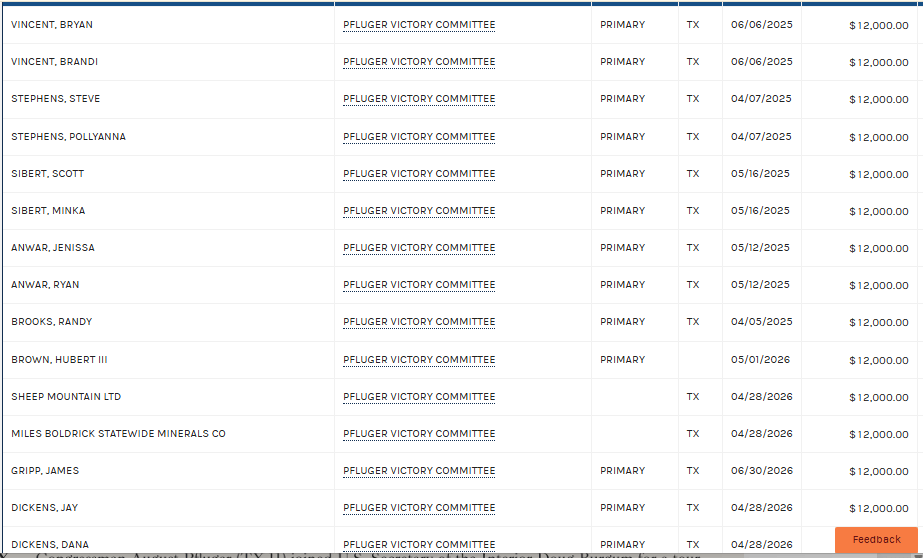
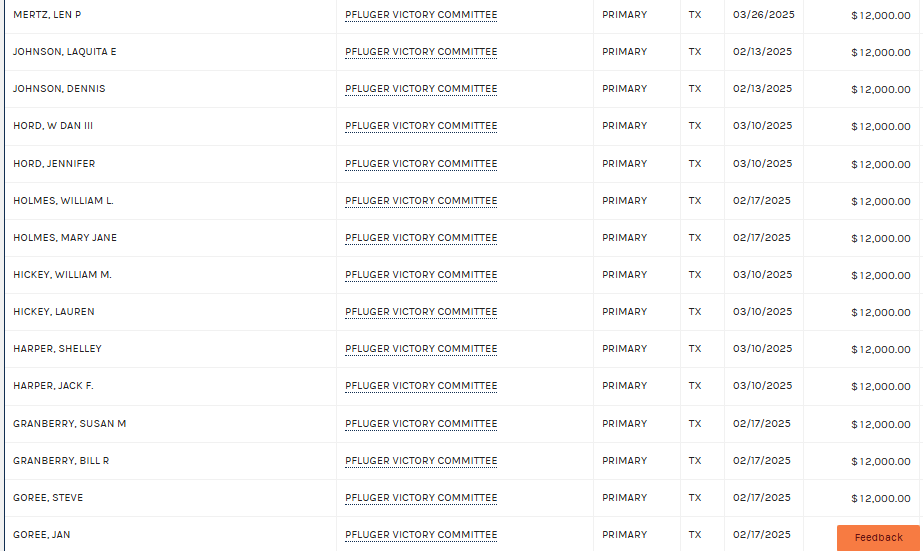
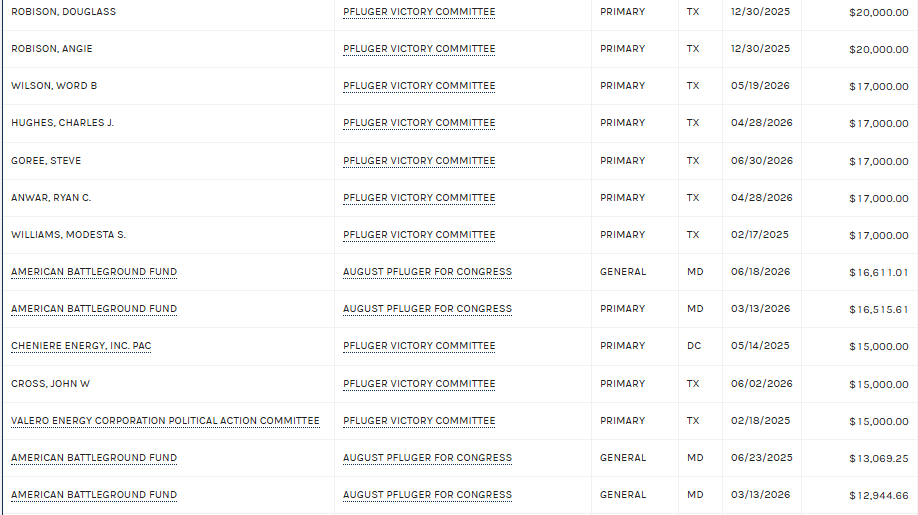
However, joint fundraising committees like the Pfluger Victory Fund accept larger split contributions from single individuals all the time, then divide them between the candidate and other PACs.
On every Republican’s donor list, there are hundreds of donors who can afford to write checks for $17,000 and more — as often as they like — and hundreds more who can chip in $12,000 a few times each election cycle, along with thousands of donors who can still give at more modest amounts like $5,000 or maybe $2,500.
Nationally, Republicans have millions of donors chipping in at around $1,000, and yet they still feel the need to collect small donations from struggling households who are supplying them with millions of dollars’ worth of contributions distributed as fractions of a dollar through organizations like WinRed.com
Through PACs and individual donations from owners and officers, legions of corporations practicing complex tax avoidance are also busy spending plenty of money on elections to keep control of the status quo — or even enhance it, a little more in their favor.
Walmart’s PAC, Caterpiller, Dimondback Energy, Entergy Corp., Cisco Systems Inc. PAC, Pacific Gas & Electric, JP Morgan Chase, NRG Energy, General Motors, Capital One, Chevron, Lockheed Martin, General Dynamics, American Express, Dell Technologies PAC, AFLAC, Disney, Merck, Abbott Laboratories PAC, Humana Inc., Altria Group, UPS, Toyota, T-Mobile, and the list goes on and on. They all give to Pfluger.
(A very long list of corporate PAC donors giving between $1,000 and $2,500 can be found here.)


Then there is a long list of donors you really have to wonder about and then investigate to get the larger picture of what a donation likely means to them.
For instance, there is Sycuan Band of the Kumeyaay Nation from California who have donated regularly to Pfluger’s groups.

The Sycuan Band is a First Nations group that operates several large economic enterprises, including the Sycuan Casino Resort.
According to information about the tribe, their primary interest in donating at the federal level is protecting tribal sovereignty, ensuring self-sufficiency, and securing favorable legislation regarding Indian gaming under the Indian Gaming Regulatory Act (IGRA), along with monitoring legislation impacting Indian Affairs.
According to leaders from many tribes, donating to influential members of the U.S. House—regardless of their state—helps ensure they have access to lawmakers who vote on regulatory committees they care about.
The Sycuan Band donates to candidates and funds for both parties, nationally and in select states, which is seen as wise, since control of statehouses and Congress can shift.

According to insiders, maintaining financial ties with both Democrats and Republicans ensures that the tribe’s federal interests, water rights, and economic frameworks are protected no matter which party holds the majority.
Then there’s AIPAC, who gave $219,959 to Pfluger according to watchdog @TrackAIPAC.
What about lobbyists and consultants and folks who make money off federal contracts? What do they want?
Not surprisingly, quite a lot of folks in those professions make significant contributions to several campaigns, and this group is definitely looking for the current system to continue on without any real change, because it’s how they make a living.


Then there are other individuals, like the CEO of the company that sells trucks all over the nation.

Mr. James E. Moeller of Waunakee, Wisconsin, is the kind of individual who can donate $5,000 to Pfluger’s campaign as part of a larger $102,000 outlay for Republicans all over during the most recent election cycle.

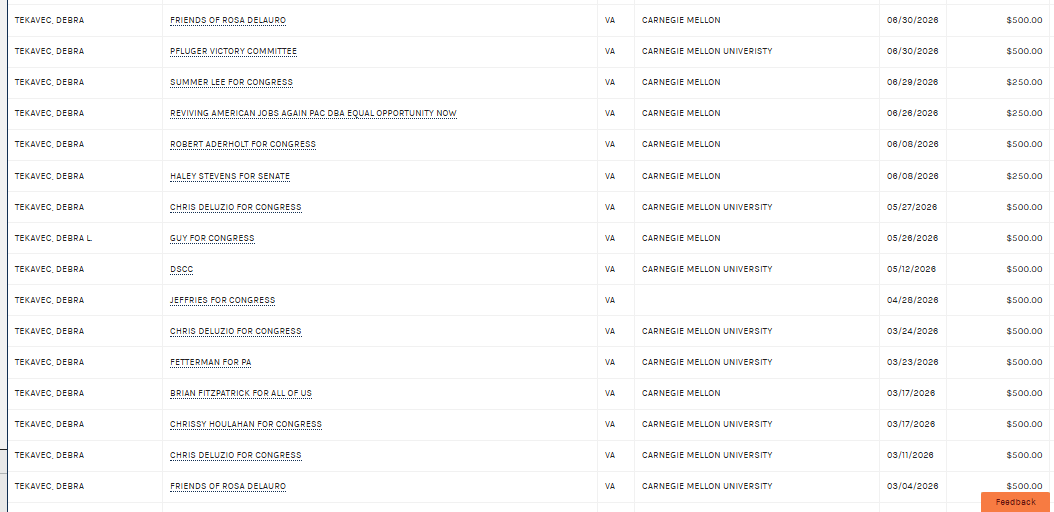
Then there are donors like Debra Tekavec, who is the Director of Federal Relations at Carnegie Mellon University.
Pfluger is a Fundraising Rockstar

One of the reasons August Pfluger is so important to the Republican Party is that he is a rock star in the fundraising world.
He is a quarterback fighter pilot and retired Air Force colonel who is good at speaking to crowds, and they keep him pretty busy doing what he is best at, so his fundraising carries him all over the country, to the kind of resort destinations where wealthy folks are likely to gather, and in Washington, D.C., where the bulk of his fundraising activities take place.

Pfluger showed his ability to draw in donations early in the game, according to a Texas Tribune report from 2019, when he managed to raise $705,000 in 19 days in his run to replace Rep. Mike Conaway of Midland, an amount the Tribune called “staggering.”
Here is why Pfluger’s pfundraising is so important to the his party.

A Special Welfare for Politicians
Although Republicans loudly decry welfare in their day-to-day rhetoric, there is a special kind of welfare just for politicians and they love it.
One of the most attractive things that August Pfluger represents to his party is that he holds a safe seat in a district full of vigorous donors.
At a national level, the party relies on seats like this to fund down-ballot elections all over the place.
The PACs and campaign funds are a massive wealth redistribution network for politicians.
An excellent example of this is Republican Rep. Lloyd Smucker of Pennsylvania’s 11th District.
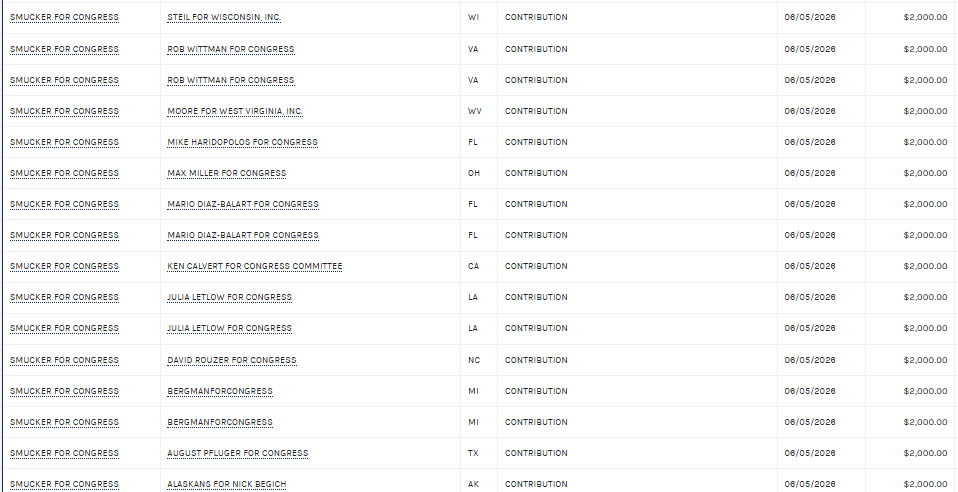
According to Smucker’s most recent quarterly campaign finance report, he made so much money he tapped his Smucker for Congress committee to donate $76,500 to 33 Republican House candidates running in districts across 23 states between April 1 and June 30 of this year, including $4,000 donations to incumbent Reps. Jack Bergman of Michigan and Rob Wittman of Virginia, and $2,000 each to several campaigns including Pfluger’s.

Smucker also sent $268,000 to the National Republican Congressional Committee in the April to June period, on top of the more than $100,000 he sent to the committee between Jan. 1 and March 31.
The NRCC is the main party committee dedicated to electing GOP House members across the country.
Reports from Smucker’s campaign finance filings show that funds from his committee are routinely channeled to dozens of fellow Republican House candidates to aid their respective local campaigns and bolster the party’s collective standing in Congress. So does Pfluger.
It is well-known that members of Congress are heavily pressured by leadership to dedicate hours of “party call time” to raise money for campaign committees like the NRCC. Public records only track the final monetary contributions, transfers, and receipts filed with the Federal Election Commission (FEC) so it is not possible to determine how many actual hours are spent on fundraising of this sort.
But, according to a 2024 report from Punchbowl.news, Texans Jody Arrington and Pfluger occupied the No. 8 and No. 9 earner spots for NRCC contributions respectively, with both of them coming up with roughly $1.1 million for the fund during that cycle. Pfluger was the vice chair of the NRCC at that time.
Since then, Pfluger has become the chairman of the Republican Study Committee, after being elected to the position in November 2024, signaling his continued rise through the ranks, as that post is seen as a major steppingstone into leadership being the largest Republican caucus.
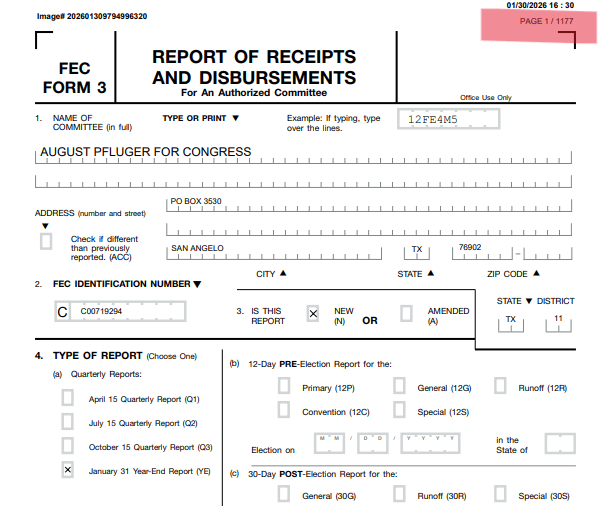
FEC.gov candidate reports can be found here.