LOCAL GOVERNMENT ROUND-UP
It seems that during his 13 years as a county official, there have been some problems from time to time with private roads being fenced off or gated in a way that prevented or restricted emergency access.
Bacon explained a procedure he worked out, based in the state’s property code, whereby folks who live off of a private road could create a permanent easement to ensure emergency vehicle access that will hold up in a court of law.
“Over the years, we’ve had some issues on private roads that have come up, and again here recently… on the way those roads have been established,” Bacon explained, noting that while the county’s subdivision standards create circumstances where commissioners have to approve the roadways laid out in a subdivision, they are still involved in addressing private roads for 911 purposes, and existing private roads and new private roads are exempt from such rules, leaving some questions about access.

“Basically, what it is… a landowner has to file with the county clerk an easement that identifies the metes and bounds of the road, who’s going to maintain the road and that stuff…. and that establishes a permanent easement.”
Bacon explained that it was not at all uncommon for a landowner to carve out a couple of acres for a child or grandkid on an existing parcel, which isn’t something that comes through the commissioner’s court, except when the new parcel needs an address.
The commissioner had clearly done a lot of legwork on the problem, and said he feels confident this procedure would put everything on a sound legal footing.
Misunderstandings Begin
Pct. 4 Comm. Shawn Nanny asked county site evaluation expert Pam Weishuhn if she thought any of that would cause her problems.
She initially asked for a little clarification on what exactly would change, regarding actual ownership and such.
Bacon said that, as an easement, this wouldn’t affect ownership and only applies to the surface rights for access purposes.
“They still own the land, but the easement prevents the roadway from being fenced off, for instance,” Bacon told her.
Weishuhn and Nanny then both asked about the 4-foot setback established for roads in subdivisions, and Bacon told them they didn’t include that 4-foot apron in this proceedure, but the easement is for a suggested width of 25-foot, and will perpetually link back to a normal-width county road.
Weishuhn then brought up a couple of developments where private roads of this sort fit neatly into the discussion.
“There’s more coming up that want to do this,” she said, “They only own 25 acres, another one they only own a 5-acre tract with 25-foot of road frontage and they want to cut it five or six ways… I told them they are going to have to create a private road.”
Bacon did a good job of again explaining about why the setback exists on county-maintained roads (because it’s illegal to tax someone on land the county effectively owns), but with the private road arrangement, the property owners would still technically own the land under the roadway.
Some further questions about road setbacks reducing acreage seemed to be muddying the waters, so Bacon clarified that this was strictly for 911 addressing and access purposes.
As the discussion progressed, Bacon told the court that he contacted our state senator and representative about this sometime ago to make them aware of this problem, but explained something needed to be done in the interim.
“There’s no clearly defined way for this to be taken care of,” Bacon said, “I had to figure out a way we could ensure unobstructed access for these future owners, and I found that in the property code where it says how to establish a private road. So now we have something, by statute, that allows for the creation of that.”
Weishuhn then asked a question about how that might be subsequently subdivided in the future, and Bacon told her if something was surveyed out and came before the court as a plat, then subdivision rules would come into effect.
The discussion began to entangle another agenda item regarding discharge of firearms and air rifles in subdivisions, and Bacon again tried to steer the conversation back to 911 addressing and access.
“This is an access easement that is being granted in perpetuity, so it doesn’t affect the property rights of what the property owner has.
“I think we’re confusing the access right versus the property rights,” he said.
Weishuhn then asked if the roadway would essentially be its own entity, and Bacon told her that was correct, and she allowed that she constantly gets questions about these things, and that there aren’t really clear answers, and Bacon agreed that the confusion was a problem.
The talk then ranged over to speculation about road maintenance and homeowners’ associations versus private ownership before County Judge Lane Carter asked how someone with a neighbor who is failing to keep up their section of road might be compelled to make good on repairs.
“Again, you’re bringing the subdivision regulations into this, and we keep that out,” Bacon said. “This does not apply to our subdivision regulations. This applies only to those properties that are exempt from our subdivision rules and regulations.
“We have the same issue right now with private roads; we’re not changing anything in that regard. I’m trying to protect those people who want permanent (911) access,” Bacon said.
Bacon went on to explain that he gets calls all the time about folks who are having problems with upkeep of private roads, and this is just a separate issue, but all things considered, a permanent easement with metes and bounds spelling out ownership and maintenance obligations should improve those issues as well, and he concluded by sharing some of his thoughts on the whole process of developing this procedure.
“I’ve been back and forth on this, and when you get into property rights… you want to stay out of that picture; this is a private property state, and the statutes and property codes clearly establish how things are done, and this happens to be in there, on how to establish a private road … and we should do things in accordance with the statutes.”
Turning to look at Comm. Nanny to his left, the two shared a moment and a laugh, as Nanny then said “I just want you to know that I have tremendous amount of respect for Comm. Bacon and his experience, but I still need some time; I thought I had all of this straight in my head, and now its muddier. Could we put this off a week? Table this for a week?
“I really need to wrap my mind around it all.”
Bacon agreed to table the item, and the court shared a chuckle over the confusing nature of the issue.
Public Comment
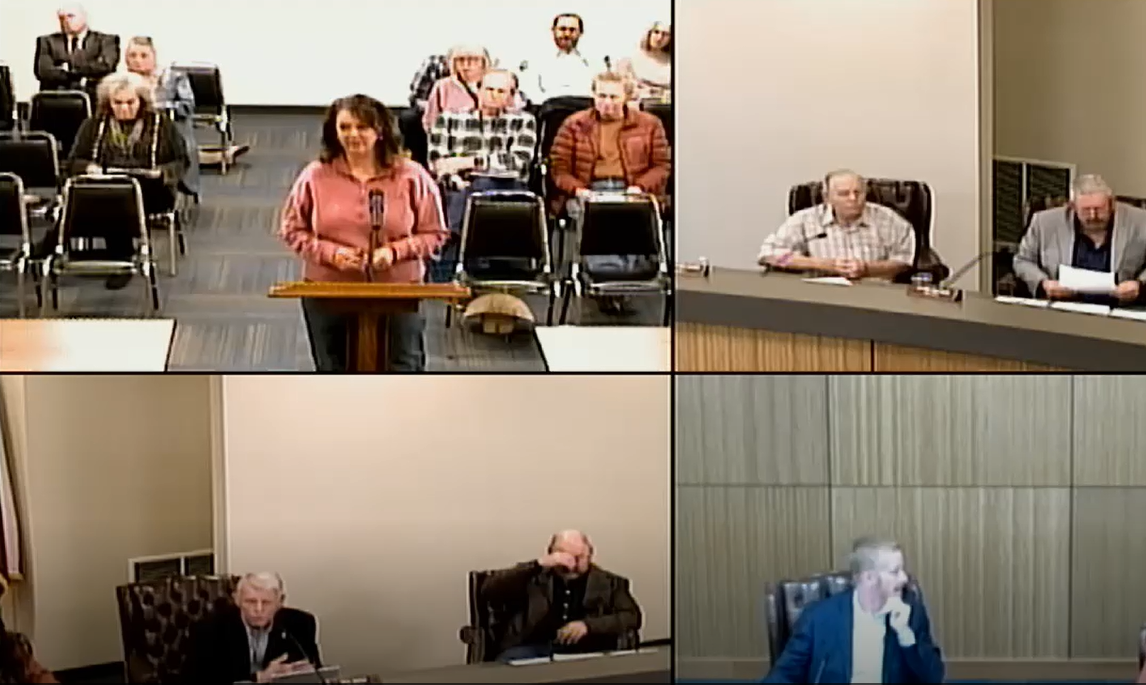
But moment’s humor was apparently lost on one woman who came to court because of her 911 addressing issue.
“I am in Christoval, and I have some of the land that’s part of this great debate, and I am requesting to be on a future agenda or to get my 911 address, ” the woman told commissioners.
She said she’s been trying to get an address since buying the 37-acre property and outlined the reasons she has been frustrated by this process.
“If we’re out there to shoot a deer with our grandson and we need an ambulance, we need an address.
“If he gets bit by a snake, or one of us, God forbid. So I’ve been researching this, and I’m not an attorney, but the State of Texas says we should be able to get a 911 address, and we’re probably exempt. We have a private road, it’s been filed.
“Mr. Nanny has the information on his desk. He told me himself. So, we need a 911 address.”
She said they do intend to build on the site, but they need an address first, and she’d like to have it today.
“We requested one, and we got the run around from every office you have; we can’t get clear definitions of what’s going on, and I’ve been researching this for months, and I believe Mr. Bacon has spoken to the facts here,” she said.
Judge Carter assured here they will have the item back on the agenda next week.
In Other Business:
The court approved a 5-year contract with Axon Enterprises for in-car cameras for two Constable Pct.1 vehicles at a cost of $25,218.
The court officially convened in special session to take public comment and answer questions pursuant to Section 235.022 Texas Local Government Code: Firearms and Air Gun regulations in a subdivision, but after a couple of folks offered testimony, the court tabled that discussion also.
The court also held a special session to canvass the results of the Nov. 3 election.