


Inside Grandma’s garage, last Halloween’s porch decorations stare back at you: a stringy, white ghost and a cartoonish witch — wart on her nose and all.
You step over unopened boxes of craft supplies.
Artificial flowers, wreathmaking ribbons, and countless bags of hot glue sticks. You have to be careful, or you might trip – there are so many things.
She hands you the packing tape. You’re packing up to move again.

It seems like each time you help Grandma relocate, you uncover more forgotten stuff.
It can feel a little overwhelming, but it’s not chaotic. It’s manageable. There’s a system in the madness. She knows where to find everything, even if no one else has any idea.
“Gosh, I’m basically a hoarder!” Grandma jokes.
But is she?
Trapped by Our Possessions
Contrary to popular belief, hoarding isn’t just about having too much stuff.
Hoarding is a clinically recognized condition, and it exists on a spectrum. Hoarding disorder can range all the way from too many things being slightly inconvenient, to a completely debilitating situation, and for many families, it’s not always clear where a loved one falls on that scale.
The truth is that Grandma’s garage resembles countless American living spaces. We’ve been conditioned to consume, and in our culture, it can be difficult to determine the difference between collecting and hoarding.
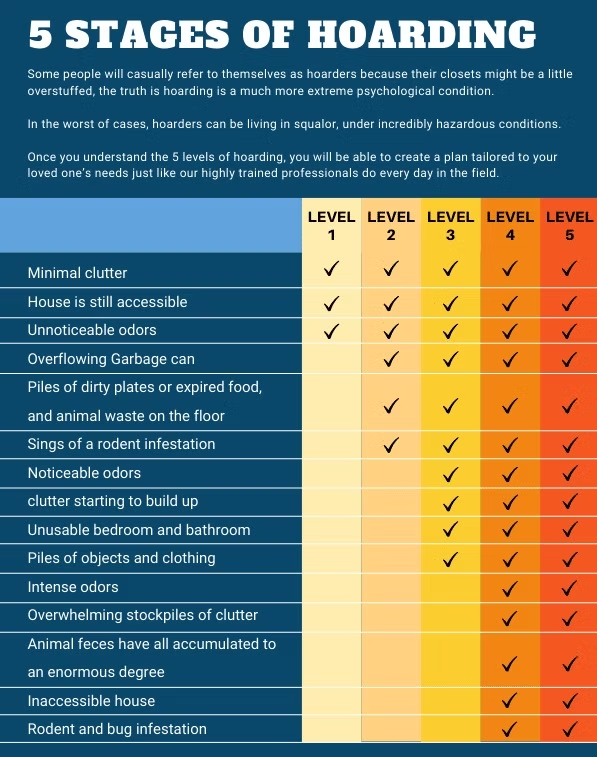
Simply having a lot of stuff or being a little disorganized doesn’t mean someone is a serious hoarder.
Clinical hoarding, especially beyond Level 3, can pose a real risk to health, safety, and wellbeing.
A person might be confined to only utilizing one room of their house, and the “things” blocking their way may be actual trash.
At that point, the accumulation of items might attract pests, block exits, or even prevent the most basic of hygiene. This can affect individuals and entire family systems. This is when professional intervention becomes necessary, to clear space and address the psychological roots of the behavior.
It’s estimated that nearly 1 in 40 people in the United States struggle with hoarding disorder, and that number may be low.
The stigma surrounding hoarding makes it hard to talk about, and the condition itself is often cloaked in shame, leaving people to feel even more isolated and misunderstood.
Because of this, people are less likely to seek help — especially when it’s hard to find.
What can we do to help?
It’s important to recognize that having a lot of belongings, like Grandma, doesn’t automatically make someone a hoarder, and casually labelling it as such can minimize what is a serious disorder.
A similar situation exists with Obsessive Compulsive Disorder, with people labeling themselves as being “so OCD” because they like things neat and orderly, when obsessive compulsive disorder is actually a serious, often debilitating condition for many.
Another way we can help is to watch out for the signs — especially following a traumatic life event, which can sometimes act as a catalyst for hoarding.
Signs of hoarding may include:
- Rapid accumulation of new items: especially if the items are being kept in places that were previously organized and tidy
- Blocked exits and pathways: keep an eye out for if the clutter is interfering with their everyday life
- Difficulty concentrating or making decisions: especially about what to keep or discard
- Increased anxiety: especially around discarding items
- Increased animal rescues: of course, helping animals isn’t a bad thing. But when the number of animals starts to exceed the capacity for care, it may hint at something deeper.
- Isolation: avoiding the subject of home and refusing company
- Fear of loss or scarcity: they save things continuously “just in case”
- Decision fatigue and decision paralysis; especially when it comes to sorting and organizing belongings.
As economic pressures tighten around the wallets of consumers, and resource scarcity settles into more communities, more families may find themselves overwhelmed by hoarding – that is a heavy burden to carry. We must remind them that they are not alone. Everyone deserves support and a safe place to thrive.
Author’s note: Considering all the social services San Angelo offers, I’ve often wondered why hoarding support isn’t more accessible and present in our community – because something makes me doubt that we are the only city where hoarding doesn’t exist.
https://www.internationalhoardingalliance.org/post/what-are-the-five-stages-of-hoarding
